
CHAPTER XII.
PYRAMID CAPACITY MEASURE;
And the Coffer's Great Pyramid authenticity.
The grand standard of capacity in the Great Pyramid, as already stated, is given by the contents or internal cubical measure, of the granite COFFER at the further, or western, end of the King's Chamber; and that, the final and crowning apartment of the whole of the interior of our Earth's most gigantic monument of stone.
But the said coffer is loose, isolated, standing on a flat floor without any guide-marks to show how it should be placed, and without the smallest hindrances (except its prodigious weight) to prevent it, in its present lidless condition, being pushed about anywhere, even through the doorway, down the long passages, and out of the Pyramid altogether, except for the contraction of one passage-way, at one particular point; viz. the first ascending passage at its lower commencement.
Even that fact too was recently disputed, for some one had said, in spite of my measures in "Life and Work" to the contrary, that there was a quarter of an inch to spare. But Dr. Grant of Cairo, accompanied by Mr. Waller, a medical man of the same place, specially looked into that matter in December, 1873; and settled it there and then by direct and immediately successive measures, with the same scale on both: the passage breadth at the indicated place, and the breadth of the coffer-vessel; Dr. Grant reporting the case as follows:—
255“The result of my measurement confirms yours: viz. the coffer in the King’s Chamber, although turned straight into the axis of the first ascending passage, could not have passed the whole way along it.

“LOWER END OF ASCENDING PASSAGE, MEASURED CLOSE TO NORTH END OF PORTCULLIS, IN BRITISH INCHES.
| Breadth from East to West, across top, or North edge, sensibly the same as the breadth of the passage itself at that point | 38.38 |
| Breadth across middle | 38.44 |
| Breadth across bottom, or South edge | 38.12 |
“COFFER IN KING’S CHAMBER.
| Breadth of North end | 38.62 |
| Breadth of South end | 38.75 |
“These,” says Dr. Grant, “are my measures, and I can vouch for their accuracy within one fourth of an inch.”
That being the case, the coffer could not have been introduced by the regular passage-way leading to the King’s Chamber, neither can it be taken out that way now, on the further account of the portcullis plug still in situ. But might it not be got out by passing it through Al Mamoun’s forced hole in the masonry to the west of the granite plug?
By dint of immense exertions, on account of the coffer’s weight, and the confined nature of the spaces through which it must be moved, it might be done.
Then in that case, why may not the real coffer have been taken away long ago, and the present one be a spurious affair of modern introduction?
If the present coffer had been so introduced, the introduction must of course have been since Al Mamoun’s day; and would have been so serious a labour, that we should have been certain to have heard something about it; over and above that such labour would have been in the way of rebuilding, refurnishing, restoring, and benefiting the Great Pyramid; and that is a totally unprecedented thing within the last 3,000 years. 256Depredations in plenty there have been up to the present hour, but no restorations.

There are, however, fortunately, far more cogent reasons to guide us, in a series of innate features of scientific measurement, never appreciated by Egyptians themselves, nor Greeks, nor Romans, nor Arabs, nor even any Europeans until now,—yet evidently, from the exactness with which these features were executed at their original date, and their many confirmations and re-confirmations of each other, they were intended by the ancient architect. Intended moreover for a further very necessary purpose; for though the coffer as a capacity measure is larger than anything now on the British Statute-book, being indeed four times the size of the quarter which is at the head there,—yet one, single coffer measure is a very small thing to set before the whole world, and ask all nations to accept it as a standard in preference to any other box or cylinder, or other shaped measure which they might have already made, or be thinking of making, for themselves.
But all this difficulty was perfectly foreseen by the inspired architect, as well as all the possible questionings as to the authenticity and contemporaneousness of the vessel with the building of the Great Pyramid, after 4,000 years should have passed over its head, and a fifth thousand had begun. Therefore it was that he identified the coffer by certain rather abstruse, yet positively identifiable, scientific features with the King's Chamber in which it is placed; and that chamber, the most glorious hall that has ever yet been constructed in polished red granite, with the enormous mass of the Great Pyramid itself; and that building with the sector-shaped land of Lower Egypt; and Lower Egypt with the centre of the inhabited land-surface of the whole world. So that, small though the coffer may be, in itself, there cannot be another vessel of such central 257importance in the eye of Nature, and to the whole of mankind also, when explained.

But who is to explain it?
Evidently it requires some one who has been favoured with wisdom. Others have seen and despised it, from Caliph Al Mamoun down to the uproarious visitors at the opening of the Suez Canal; but we have been already told in Holy Scripture that there are things which, though absolutely inscrutable to the world at large, yet nevertheless the wise shall understand them. And if the chief explanations which I am now about to quote, have been furnished by Mr. James Simpson, known only as a young bank clerk in Edinburgh, and who never had the advantage of University education,—I care not for the world’s objections,—he has been favoured with peculiar wisdom from on high, and has been privileged to throw upon this ancient subject a light it never enjoyed before, within the history of all civilised times.
But let us come to the point and the proofs.
The Size of the Coffer, and its Pyramid Connections thereby.
For the full measures of all the particulars of the coffer, the reader must be still referred to the several pages containing them in Chapter VIII. But we may consult his convenience by repeating the chief mean results of them here,—as thus:
OUTSIDE MEASURES OF THE COFFER IN PYRAMID INCHES.
Length, from 89.92 to 89.62, corrected for concavity of sides. Breadth, from 38.68 to 38.61 ,, ,, Height, from 41.23 to 41.13 ,, ,,
INSIDE MEASURES OF THE COFFER IN PYRAMID INCHES.
Length, 77.85, supposed to be true within half a tenth of an inch. Breadth, 26.70, ,, ,, ,, Depth, 34.31, ,, ,, ,, Thickness of bottom .. .. .. = 6.91 Pyramid inches. Thickness of sides .. .. .. = 5.98 Do. do. 258Now all these numbers are necessary to be kept in mind, for they have all a part to play in the proofs to come; and from the manner in which they are given, it will be seen that I have so far neglected the ledge cut out. I have done so; have in fact virtually filled it up; as indeed the mere overlooking it, is quite enough to bring about; and as evidently should be done by the wise, when they thereby obtain what must have been the original form; and which, in all its apparent geometric simplicity, is yet fraught with manifold design.

We have already shown, and Professor H. L. Smith, of New York has independently confirmed, with regard to the coffer, taken in and by itself, that—
| Pyramid cubic inches. | ||
| Exterior cubic size | = 142,316 | nearly. |
| Interior cubic contents | = 71,317 | |
| Also that, Sides of coffer, cubic size | = 47,508 | nearly. |
| Bottom of coffer, cubic size | = 23,758 |
And these relations, so like the duplication of the cube problem among the Greeks,1 are found in a vessel of
The peculiar drift of the oracle in gaining time reminds of a case described by the Rev. Dr. Moffat in Bechuana Land, in South Africa. The country was perishing from drought, and the people applied to their atheistical witch rain-maker to stop it. He promised certainly to do so if the people brought him a full-grown baboon, without spot, blemish, or injury of any kind. Now, the said baboon being one of the most active and wary of animals, and roaming over the most inaccessible rocky summits of the hills, gave the unlearned South African savages just as time-consuming a problem as the duplication of the cube was to the intellectual Athenians. 259strict geometrical figure, without carvings or any other adornment than exquisitely planed, and almost true, and smooth surfaces, as see the copies of Dr. Grant's and Mr. Waller's cast of them on Plate XVIII.; where they, the sides of the coffer, are the facile princeps, in point of smoothness, of all the various examples of worked granite surfaces. But now for the connections with the red granite chamber, which the coffer is placed in; and with the Pyramid building itself.

(1.) The chief line of the whole King's Chamber is geometrically its cubic diagonal, and that has been certainly now ascertained by modern measure, assisted by computation, to be equal to 515.165 Pyramid inches. This is Mr. Simpson's base-line from which he reaches up to the Great Pyramid on one side, and down to the coffer on the other; thus:—
(2.) side of a square of equal area with the Great Pyramid's vertical, right section.
(3.) twice the greatest horizontal circumference of the coffer; nearly—
(4.) (A.) the mean length of all the coffer's "arris," or edge lines.
(B.) Diameter of a circle whose area is represented in the coffer's interior horizontal area; i.e. its inside floor.
(C.) Side of a square whose area mean area of the four external vertical sides of coffer.
(D.) The diameter of a sphere, whose contents (71,588) come very near those of the hollow part of the coffer, and do, in a sense, exist there.
(E.) The diameter of a circle in which the natural tangent of α Draconis (the Pyramid's Polar star at the date of erection) was at its higher culmination, viz. 33° 41′ 20″ 34.344 Pyramid inches coffer's depth.
So exactly, though extraneously, appears thus to be given the coffer's depth, that very element, which the senseless hammerings of modern travellers breaking off specimens of the material, forsooth,—have now very nearly deprived the world of seeing again in the body.
(5.) At the same time the external correlative of inside depth, namely, the height, is given simply by the tenth part the length of the King's Chamber containing it, viz. 41.213.
260(6.) While the breadth of the coffer’s base is given thus, based on the number of days in the solar year:—In a circle with circumference = 365.242 Pyramid inches, the natural tangent of 33° 41′ 20″, or the Pyramid Polar star’s upper culmination = 38.753 Pyramid inches, = breadth of coffer’s base; and again = ante-chamber’s length 116.260 divided by 3.

(7.) The depth and height are moreover thus related:—
If 103.033 Pyramid inches was found an important touchstone of commensurability in the King’s Chamber, bringing out Mr. Simpson’s “sums of the squares there,” we may expect to find it in the coffer also; where accordingly—
(8.) = area of four external sides of the coffer, nearly.
(9.) = 34.344 = depth of coffer.
(10.) = height of the coffer squared.
This last theorem brings into view the invaluable quantity , which the Great Pyramid commemorates by the shape of its whole external figure: and Mr. St. John Vincent Day had announced long since, that, profiting by small inequalities between the sides of the coffer, as shown to exist by my measures of them, it could be proved that the height of the coffer is to the length of two adjacent sides (viz. a side and an end) as 1 to . And now to that good beginning, Mr. Simpson adds,—
(11.) Coffer’s internal floor has a boundary whose length = the circumference of a circle of equal area to coffer’s outer floor or base; a curious result this of the long shape of the coffer, compared with the cube, or cylinder, which it might have been for capacity measure alone, and of which more presently.
(12.) Coffer’s depth multiplied by = area of East and West (that is, the two long) sides of the coffer.
(13.) Coffer’s height squared = area of .
(14.) A circle with diameter 38.753 Pyramid inches (the breadth of the coffer’s base); or again
A square with side 34.344 Pyramid inches (the depth of the coffer), has an area = the area of the external long side divided by .
(15.) Finally, if two vertical, right, sections be made through the middle of the coffer, then such are the proportions of lengths, breadths, and thicknesses, that
(A.) Area of the sections of the walls of coffer, is to area of whole section included, as 1 to . And
(B.) Area of sectional walls = height of coffer squared. 261Then follow some most interesting correspondences, with distinctions, between these three apparently most diverse things, the pointed Great Pyramid, the enclosed King's Chamber, and the lidless granite Coffer; thus—

(16.) In each of these three structures, one rule governs their shape, viz. two principal dimensions added together are times the third.
Illustrated thus:—
Wherefore Pyramid and Coffer have their radii vertical, and King's Chamber horizontal.
Professor Hamilton L. Smith, of New York, has also been privileged to discover many remarkable commensurabilities between the coffer and other signal portions both of the Great Pyramid, and some natural data, such as the number of days in the year; these latter commensurabilities evidently requiring that the measures of the coffer be expressed in Pyramid inches, and in no other units of a different length from them. These discoveries are not yet fully published—some of them will be noticed in a future chapter.
Position of the Coffer in the King's Chamber.
But now, still further, for the position of this remarkable vessel, the coffer, in the equally remarkable room, the King's Chamber. To a certain extent I have almost foreclosed against myself the possibility of having anything of importance to say there,—having described the coffer as loose on a flat, smooth, unmarked floor, and having also spoken of one end being tilted up, by a nodule of hard jasper from the desert outside, pushed in by Arabs in modern times. It is the south end which is so tilted, and in committing that abomination 262the ignorant children of the desert of to-day, seem to have pushed the coffer ten inches towards the north, of where it had been intended to stand; for on subtracting that quantity from my measured distance (see “Life and Work,” Vol. II. p. 105) from the south wall, and adding it to what was measured from the north wall, each distance comes out 58.2 Pyramid inches; or, within the limits of the errors of observation, it = the height of the Great Pyramid divided by 100.

Encouraged by this indication, Mr. Simpson considered the distance of the west side of the coffer, from the west side of the chamber. The slued position of the coffer (see Plate XVII.), evidently indicates that the men who recently pushed it northward while tilting it, moved it, chiefly at the elevated south end, a little eastward too. My present measured distance therefore from the west, 55.0 inches, is rather too great. What distance then ought it to have been in such a monument as this, where everything evidently goes by number and measure?
What else, replied Mr. James Simpson, than the coffer’s touchstone length, 51.516 Pyramid inches? Allowed pro tem.; but what length does that leave between the eastern side of the coffer, and the eastern side of the chamber?
Nay, said he, take it not from the far-off eastern wall of this long chamber, but from a meridian plane cutting the chamber into two equal halves, and then you will find the quantity 116. inches; sufficiently near to the length of the ante-chamber, or to the tenth part of the coffer’s own height above the base of the Great Pyramid, to be accepted as intentional by the architect of the whole; and yet sufficiently far from the 116.26 of the ante-chamber’s rigid measure to permit of a further reason being investigated by-and-by.
Meanwhile it may be observed that we have, theoretically, divided the King’s Chamber, transversely to its 263length, into two equal halves. Is anything else gained by that?

This most important illustration of the very groundwork of the claim of the coffer to be a vessel of capacity having an earth-size reference. At p. 180 we showed its formation upon the cube of a line of the length of 50 inches, or two of the remarkable cubits of the Great Pyramid, each of which cubits is memorable through all science and all history as the ten-millionth part of the earth's semi-axis of rotation, for the period of intellectual man residing on this planet world.
Now that “ten-millions” is a large number, but very round, very exact, and very characteristic; and if we take the precise breadth and half length of the room as determined before (p. 194), 206.066 Pyramid inches, and for height, the larger 2nd height also given before, say 235.5, we obtain almost exactly 10 million cubic inches, as the contents of each half of the room; or indicating that something is accomplished there connected with capacity measure, and depending primarily on a length of two such cubits, as these earth-axis commensurable ones of the Great Pyramid are, commensurable each of them by ten millions.
The Shape of the Coffer.
The earth-size relations then of the coffer, as deduced for itself alone, are justified by the whole King's Chamber; and the actual size, we showed before (p. 154), is Pyramidally recognised by the lower course capacity of the chamber being 50 times the contents of the coffer, and the coffer standing on the 50th course of the masonry of the whole of the Great Pyramid from the pavement upwards. But the shape; yes, the shape of the coffer as a capacity measure—what is to justify that?
We have already given a variety of reasons of a 264somewhat mathematical order at p. 163, but have no objection now to add thereto this general verbal apology:—that the shape of the coffer is to enable it, with its elemental-founded size, to typify and be most suitable to the size, shape, forces, and purposes of man; not of man trying to scale the heavens by his own might, but of man living in obedience to, and dying in harmony with, the commands of God his Creator.

John Taylor had suggested, but not very strongly, that the shape of the coffer was derived from the hot bath, the Calidarium, long known in the East—a long and deep box-shape in which a man might lie down at full length, or sit up; and such a shape, he showed, had been found more convenient for a corn-holder, or large corn-measure, than a cube of the same contents.
But in presence of the 4,000 years and more, which the Great Pyramid now represents to man,—the most solemn case of lying down is that of the tomb; and the full length, horizontal extension is as characteristic of what was ever taught in the Hebrew or Christian religion, as it was radically opposed to the wretched, bent-up, and shortened attitude of some miserable idolaters, and of the Parsees in India in the present day, or the cremation methods of Hindoos, or the ancient Egyptian plan of bringing out the mummies of their ancestors, and setting them up round the dinner-table at the greater family feasts.
The very look of the coffer evidently does produce in some human minds the idea of solemnly and religiously lying down extended in length, looking upwards, peaceful and strong in faith of a future awakening by the power of God. Wherefore only this last month (1877) an American newspaper, recounting a recent visit to the King's Chamber of the Great Pyramid, mentions how the clergyman of the party, the Rev. Dr. —— insisted on laying himself down full length inside the coffer.
265He had heard the Inspiration, and Scientific, Metrological theory of the Great Pyramid duly related by Dr. Grant, and had not denied it; but so strongly was he imbued with the mere tombic idea of the Egyptians, that he held, as he lay there, with the notion that he was lying down in a Royal coffin; and when he, Dr. ——, rose up from that open granite chest and found himself filthy, horrible, odious, with fine grey dust begriming his hair and transfusing his clothes,—he, Egyptologically, remarked, that it was “the honour-imparting dust of King Cheops.” And yet so very far was it from being anything of the kind, that—over and above Cheops having been buried, as Herodotus relates, in quite another place (see p. 130), and the coffer having been often filled and emptied again of rubbish in modern times, as with Dr. Lepsius and his date-palm for a German Christmas-tree,—I can testify to this,—that, previously to my measures in January, 1865, I had the coffer cleared out, and washed both inside and outside with soap and water. Hence the detestable powdery matter which the Reverend Doctor so willingly courted, was, if not actually plebeian, at least so very modern as to be the product in situ of the last twelve years only: and is contributed chiefly by the limestone dust (gathered in pushing through the earlier passages and the rubbish of Al Mamoun’s hole, and then shaken out of the clothes of the swarms of travellers, as they dance their violent reels in the noble granite hall), by the pungent excrements of bats startled in numbers on account of the unearthly howls, and by the slowly subsiding smoke of innumerable flaring candles. But leaving the Doctor to cleanse his garments as best he may (and he himself says he had a great deal of trouble about it; for not until he had got right away from Egypt, and obtained the help of the steward’s assistant on board ship, to give the clothes an extra beating over the waves of the rolling

266sea,—was the last of the penetrating powdery stuff got rid of) let us return to our metrological inquiry.

Practical application of the Coffer in Capacity Measure.
Having already said so much in point of principle and theory for the coffer, we may now approach the final object of this chapter; viz. the practical uses in capacity-measure of the granite coffer of the King's Chamber; a vessel measuring, as its architect originally intended that it should, 71,250 cubic Pyramid inches, or something very close thereto.
The whole quantity subdivides itself easily, after the manner of the Pyramid arithmetic and Pyramid construction, as follows:—the two most important steps being, first, the division into 4, as typifying the four sides of the Pyramid's base; and second, the division into 2,500, or parts; fifty being the special number of the room, and the number also of the masonry courses of the whole structure on which that chamber, or rather the two adjoined chambers of ten million cubic inches each, of which it is composed, rest in their places.
PYRAMID CAPACITY MEASURE.
| Division, or number, of each denomination contained in the whole coffer. | Intermediate divisions. | Capacity of each denomination in Pyramid cubic inches. | Equivalent Weight in Pyramid pounds of Water. | Name now proposed to be given to each successive portion. |
|---|---|---|---|---|
| 1 | 0 | 71,250,, | 2,500,, | Coffer. |
| 4 | 4 | 17,615,, | 625,, | Quarter. |
| 10 | 2.5 | 7,125,, | 250,, | Sack. |
| 25 | 2.5 | 2,850,, | 100,, | Bushel. |
| 250 | 10,, | 285,, | 10,, | Gallon. |
| 2,500 | 10,, | 28.5 | 1,, | Pint. |
| 25,000 | 10,, | 2.85 | 0.1 | Wine glass or fluid oz. |
| 250,000 | 10,, | 0.285 | 0.01 | Tea-spoon or fluid dr. |
| 25,000,000 | 10,, | 0.00285 | 0.0001 | Drop. |
267We begin, therefore, with the large measured and scientific quantity of the coffer; and end with a unit which, in an approximate form as a drop (i.e. the cubical space occupied by a drop of water falling freely in air at a given Pyramid temperature and pressure), is in everyone’s hands, and is definable accurately upon the coffer by the stated proportion.

In contrasting this arrangement with the British imperial system, we may see at once that that modern system is merely a measure for large and rude quantities, knowing of nothing smaller than the pint (the gill being merely a later tolerated addition to suit special wants), and rendering it therefore necessary for the apothecaries and druggists to manufacture a sort of fluid and capacity measure for themselves, which they do by starting from the pint and ending in the drop; or, as they term it, with needless addition of dog-Latin, a “minim.”
This apothecaries’ fluid measure was established only in 1836; and we may assume, with Lord Brougham’s Penny Cyclopædia, that such fluid ounce, when it is an ounce, is an ounce avoirdupois; although it is stated elsewhere that medical men are never to use anything but troy weight.
This incongruity renders the break between imperial, i.e. the present British, capacity, and apothecaries’ capacity, measures peculiarly trying; followed as it is by a break of connection between apothecaries’ capacity, and apothecaries’ weight, measures also.
In the Pyramid arrrangement, however, there is no halting half-way; but, when it is a question of capacity, the scheme goes right through from the biggest bulks ever dealt with in commerce, and through all the measures required by the people further in dealing with coal, corn, wool, potatoes, beer, wine, peas, meal, oil, medicines, photographicals, and chemicals, up to the 268smallest quantity ever judged of by capacity measures of specified name; for when once we have arrived by several decimal stages at “drops,” no one would ever think of subdividing them further, if he could, in any other manner than by the tens of pure arithmetic again and again.

But the chief unit of the imperial capacity system is a pint; and it is, moreover, the very important centre of connection between that system for large ordinary quantities, and the apothecaries’ system for scientific and medical small quantities. The pint occupies, therefore, the position of all others on the scale which should be round and complete, testable also at a moment’s notice by an equally round, well-known, and frequently employed standard of weight.
So it was too in the days of the wisdom, wherever that was derived from, of our Anglo-Saxon forefathers, or the times of instinctive strength of our hereditary traditions; but under the reign of George IV. the pint, from having been measured by one pound’s weight of water, was expanded into the odd quantity of 1 and pounds. And the change was attempted to be electroplated with brilliant proverbial mail, by giving out this jingling rhyme, to be learned by all good subjects,—
> “A pint of pure water > Weighs a pound and a quarter.”
But we may well venture to doubt whether every peasant does not rather still ruminate in his family circle and about the old hearthstone over the far more ancient and pithier rhyme,—
> “A pint’s a pound, > All the world round.”
An expression, too, in which there may be vastly more than immediately meets the eye; seeing that the Pyramid system appears to restore the principle; and, what 269with the United States of North America, true to their ancient, hereditary covenant, and all the existing British Colonies too, does form, as prophecied of old, the measuring line round the whole world.

At all events, to those who now enter the Great Pyramid, and look with understanding eyes, one of the first things set before them in that microcosm of the King’s Chamber, the Ante-Chamber thereto, is the Boss on the granite leaf. Which Boss, over and above having served in lineal measure to perpetuate the inch, is now found in its cubic capacity to represent approximately the Pyramid pint; the Pyramid pint too, visibly standing vertically over the lower stone of the leaf, proved already (see p. 209) to show the size of the ‘“‘ Quarter” measure of the system.
Almost every one of the Pyramid’s capacity measures, however, over and above its pint, with its weight-equal the pound, admits of being tested by a round number of ‘“‘water-pounds”’; and that number is always such a one as we shall presently see equally exists in the Pyramid system of weight measure.
We have, therefore, only to conclude this division of the subject by submitting a table of comparison of each concluded Pyramid capacity vessel, with each similarly named current capacity vessel in Great Britain (and almost, if not exactly the same in America) through means of the known medium of British cubic inches. Whence it will be seen that, excepting the “coffer,” (though even that is hardly altogether unknown to our nation, “chaldron” having been under Anglo-Saxon rule an expression for, and a description of,2 it,) there is no need to invent any new names; for, under the existing ones, as of pints, gallons, &c. &c., the absolute capacities have often varied much. more 270than here indicated,3 and without a tithe of the reason for it.

PYRAMID, AS COMPARED WITH BRITISH, CAPACITY MEASURES,
Compared through the temporary medium of British cubic inches, exactly suited to neither.
| Coffer, Pyramid | = 71,463.750 | Four Quarters, Brit. | = 70,982.144 |
| Quarter ,, | = 17,865.938 | Quarter ,, | = 17,745.532 |
| Sack ,, | = 7,146.375 | Sack ,, | = 6,654.574 |
| Bushel ,, | = 2,858.550 | Bushel ,, | = 2,218.196 |
| Gallon ,, | = 285.855 | Gallon ,, | = 277.279 |
| Pint ,, | = 28.585 | Pint (Old W. Pint = 28.875) | |
| = 34.659 | |||
| Ounce or Wine-glass | = 2.858 | Ounce, fluid, Apoth. | = 1.733 |
| Dram or Tea-spoon | = .286 | Dram, fluid, Apoth. | = 0.217 |
| Drop, Pyramid | = .003 | Drop, Apoth. | = 0.004 |
INTERNATIONAL APPENDIX TO GREAT PYRAMID CAPACITY MEASURE.
If analogues of the Great Pyramid measures are thus found in the oldest metrology of the Anglo-Saxons presently known, some traces of them can hardly but be discoverable also in the hereditary metrologies of other countries, through which the Anglo-Saxons marched before they occupied these British Isles 1,200 years ago.
271Without, then, attaching any particular importance to the results, I append here some of the most striking approaches to coincidence, chiefly gathered from Dr. Kelly's "Universal Cambist," published in 1821. Dr. Kelly having been an author of the most respectable class in commercial and educational science; and one who, though the French metrical system had already appeared on the horizon in his time, yet lived in the full force of the older hereditary metrological systems—systems perverted often exceedingly into provincial variations, but not then begun to be stamped out of existence wholesale, for the benefit of the mètre of Paris.

"Quarter" Capacity Corn Measures.
| Country or City. | Name of Measure. | Contents in English cubic inches. |
|---|---|---|
| Ancona .. .. .. | Rubbio .. .. | 17,459· |
| Malta .. .. | Salma .. .. | 17,678· |
| Great Pyramid .. | Quarter of Coffer .. | 17,866· |
| Rome .. .. .. | Rubbio .. .. | 17,970· |
"Sack" Capacity Corn Measures.
| Country or City. | Name of Measure. | Contents in English cubic inches. |
|---|---|---|
| Amsterdam .. .. | Mudde .. .. | 6,788· |
| Bolsano .. .. | Scheffel .. .. | 6,657· |
| Deventer .. .. | Mudde .. .. | 7,049· |
| Genoa .. .. .. | Mina. .. .. | 7,367· |
| Hanau .. .. .. | Malter .. .. | 6,868· |
| Great Pyramid. .. | Sack .. .. | 7,146· |
| Reval .. .. .. | Tonne .. .. | 7,219· |
| Turin .. .. .. | Sacco .. .. | 7,015· |
| Zwoll .. .. .. | Mudde .. .. | 6,851· |
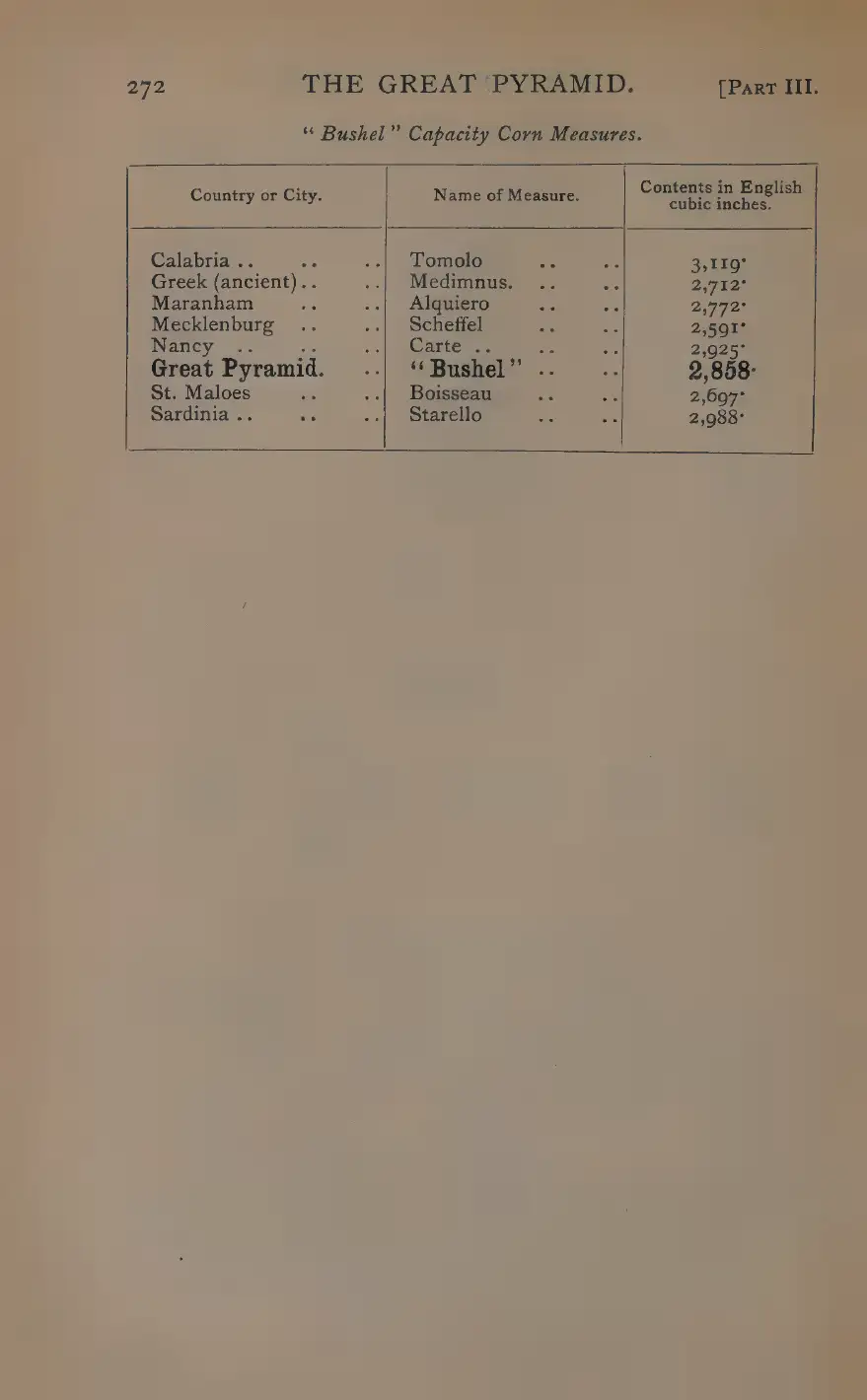
"Bushel" Capacity Corn Measures.
| Country or City. | Name of Measure. | Contents in English cubic inches. |
|---|---|---|
| Calabria | Tomolo | 3,119 |
| Greek (ancient) | Medimnus. | 2,712 |
| Maranham | Alquiero | 2,772 |
| Mecklenburg | Scheffel | 2,591 |
| Nancy | Carte | 2,925 |
| Great Pyramid. | "Bushel" | 2,858 |
| St. Maloes | Boisseau | 2,697 |
| Sardinia | Starello | 2,988 |