
CHAPTER XIV.
LINEAR AND SURFACE MEASURE,
Strictly Earth-commensurable.
WE have now arrived at the commercial arrangement of the most important of all the measures of a nation; at that one which requires practically to be attended to first, and which was first attended to, and secured with more than sufficient accuracy, as well as with the grandest of suitable and harmonious earth-commensurability, in the Great Pyramid; viz. linear, or length, measure. And, after all that was accomplished in laying out the exterior of the building in terms of this standard, we have seen in Chapters X. and XII., that the interior arrangements of the Pyramid are similarly laid out; and there, both in a harder material and in a constant temperature which brings all standards of all materials into a uniform and intercomparable condition, most unexceptionably.
The particular standard of length measure for the Great Pyramid, viz. its 25-inch cubit, the one-ten-millionth of the earth's semi-axis of rotation, has its length most exactly ascertainable by modern measure (combined with an understanding formula, so as to take advantage of a multiple of the single standard arranged by the Architect himself), in the King's Chamber; where, as Professor H. L. Smith has well shown, it is given with surpassing accuracy by the expression: Cubic 291diagonal of the room multiplied by 10, and divided by the breadth of the floor. That is, in Pyramid inches deduced from the British inches of my actual measures of the said chamber in 1865 (see Chap. X.), Pyramid, or 25.025 British, inches.

This, too, is evidently the length to which, in a concrete, single, and distinctly separate shape, we were also introduced by the granite leaf in the ante-chamber, as already detailed in Chap. X.; and are still to be introduced by the Excentricity adjustment of the grand Niche in the Queen’s Chamber (see Chap. XIX.). While the granite-leaf still further shows the subdivisions of a single cubit, first into five grand hand-breadths, and then each such hand-breadth into five parts (25th parts of the whole cubit), which parts we will call, in our language, “inches of the Great Pyramid.”
Now any one of these inches is the unit, unit-standard if you like, of the Great Pyramid linear measure. Accurately, this inch is the 1-500,000,000th of the earth’s axis of rotation; but approximately, a thumb-breadth, to any full-sized, able-bodied man who has ever lived on the earth during the last four thousand years. In that long interval of anthropological time, what mighty empires, what varied races of men, and what languages too, have arisen and have passed away again from the face of the world! Therefore, of the present words and phrases, laws and customs, which rule in modern society, whether scientific, political, or commercial, which of them can expect to continue to control the actions and thoughts of men for anything like a similar period to this rule of the inch; or for the next forty centuries of years?
A thumb-breadth, then, is, both chronologically and historically, no indifferent test reference of approximation, to every poor man in Great Britain, for realising, when in haste, the unit of his measure also of length; 292and keeping up some identity in his works with those of his fathers from earliest history, and even before history. Wherefore it is only characteristic of human nature in the large, that the working-men of Newcastle, according to the unintended testimony of Sir William Armstrong before the British Association of 1863, have once more practically, by their deeds and in their works, pronounced indubitably for the inch (an inch, too, decimally subdivided), wherever extreme accuracy is concerned.

The Unit of British Long Measure, really the Inch.
It was so in our olden national times as well; viz. that the English unit was the inch, and not any of those larger measures of yards or mètres, which the wealthy have been endeavouring to get established of late.
The old Exchequer standards, spoken of in 1742 (strong bars of gun metal, square in cross section and slightly convex at the ends, to suit “end measure”), marked E for Queen Elizabeth, and supposed to date from 1580, were, as reported at the time, one a yard, and one an ell; but that did not make either the one, or the other, the unit of the country’s length measure. Where the unit is small, the public standard must inevitably consist of a number of such units strung together; and the incommensurability, except through their component inches, of that pair of measures laid side by side, the yard and the ell, might have reminded men in subsequent times of the true state of the case.
But it did not; and that the efforts of the ruling classes in making so much, as they have during late years been doing, of the yard, were intended to establish it as a new unit, and not as a convenient number of the ancient small inch units arranged together to suit a special purpose of manufactures and commerce, the 293following words of the Act (June, 1824) sufficiently testify :—

"The straight line or distance between the centres of the two points in the gold studs in the straight brass rod, now in the custody of the Clerk of the House of Commons, whereon the words and figures standard yard of 1760 are engraved, shall be, and the same is hereby declared to be, the original and genuine standard of that measure or lineal extension called a yard; and that the same straight line or distance between the said two points in the said gold studs in the said brass rod, the brass being at the temperature of 62° of Fahrenheit's thermometer, shall be, and is hereby denominated, the imperial standard yard, and shall be, and is hereby declared to be, the unit, or only standard measure of extension."
Yet a yard unit would be by no means generally acceptable, even by those desiring something large; for we have already seen the favour extended in Queen Elizabeth's time to the 45-inch ell; while both the Astronomical Society's new scale of 1835, as well as those of Troughton, Sir George Shuckburgh, and others, were oftener of five feet than three. At three, however, what is now by modern law, in defiance of history and fact, the unit of our country's linear measure, has been eventually settled by the last Parliamentary Commission ;* and at three feet it will legally remain until some great constitutional exertion be made to rectify it.
* The commission of 1838 had been thorough enough to consider, at least according to its lights at that time, all the following points :—
A, Basis, arbitrary or natural, of the system of standards. B, Construction of primary standards. C, Means of restoring the standards. D, Expediency of preserving one measure, &c., unaltered. E, Change of scale of weights and measures. F, Alteration of the land chain and the mile. G, Abolition of troy weight. H, Introduction of decimal scale. I, Assimilation to the scale of other countries, &c.
294During all these twenty or thirty past years, too, that it has remained there, a most artificial quantity, and naturally incommensurable with anything grand, noble, sublime,—there never seemed to be the slightest suspicion amongst any of the Government Commissioners, until John Taylor announced it from his Great Pyramid studies, and Sir John Herschel followed with scientific confirmations, that each single one of the 36 really unit inches of which the modern British Government's standard, and erroneously called unit, yard is composed, contains within itself all that much-desiderated physical applicability and scientific perfection,—when each individual British inch is, almost exactly, the 1-500,000,000th of the earth's axis of rotation already referred to.

The old British Inch closer to Earth-commensurability, than the modern British Inch.
Almost, or only,"and not quite though, at this present time; for it requires 1.001 of a modern British inch to make one such true inch of the earth and the Great Pyramid. An extraordinarily close approach, even there, between two measures of length in different ages and different lands; and yet if any one should doubt whether our British inch can really be so close to the ancient and earth-perfect measure, I can only advise him to look to the original documents, and see how narrowly it escaped being much closer; and would have been so too in these days, but that the government officials somewhere in the "unheroic" eighteenth century allowed Queen Elizabeth's ell measure, of equal date and authority with the yard, and of a greater number of inches (45 to 36), and therefore, in so far, a more powerful standard,—to drop out of sight.
The modern inch now in vogue amongst us was derived from the Exchequer yard standard, through 295means of Bird’s copy in 1760 and other copies, and was therefore intended to be one of the inches of that particular yard; but the inches of the Exchequer ell were rather larger inches, and there were more of them; so that if either standard was rightfully taken as the sole authority for the value of an inch, it should have been the ell. Now when these standards were very accurately compared by Graham in 1743, before a large deputation of the Royal Society and the Government,1 it was found that the Exchequer ell’s 45 inches exceeded the quantity of 45 such inches as the Exchequer yard contained 36 of, by the space of 0.0494 of an inch. A result, too, which was in the main confirmed by the simultaneous measures of another standard ell at Guildhall, with an excess of 0.0444 of an inch, and the Guildhall yard with the excess of 0.0434 of an inch; showing that at that date generally, the English inch was larger than it is now by the amount of very nearly the 0.001 of an inch which we find with the Great Pyramid inch.

Keeping, however, for minuter details only to the Exchequer standard ell; and finding that it was not, after all, the very Exchequer yard, which was subsequently made (in Bird’s copy) the legal standard of the country, that said ell was compared with by Graham, but a previous copy of it, and found in 1743 to be in excess by 0.0075 of an inch, on the Royal Society’s scale,—we must subtract this quantity from the observed excess of the Exchequer ell; and then we get that its 45 inches were equal in terms of the present standard inches of the country, to 45.0419.2
The problem set before Colonel Strange, in 1864, was, to obtain
296But 45 Pyramid inches are equal to 45.0450 modern English inches; whence it will be seen, of those earlier English inches, that they had such a truth, a justness, and a closely earth-axis commensurable quality, that it required an addition of only 0.0001, or no more than the twentieth part of a hair's breadth, or of rather less than that still, to make one of those early English inches perfectly equal to a Pyramid inch: and will cause every well-wisher of his country to perceive that the inch must be

that time, in the then legalised and Government inches of our country, a direct measure of the Exchequer's Queen Elizabeth's standard ell rod; i.e. the gun-metal bar decorated with the royal crown and E at each end, and safely preserved in the Exchequer, it is believed, for close on 300 years.
Colonel Strange kindly undertook the task, and having obtained formal leave from H.M. Exchequer and the Lords of the Treasury, proceeded thus:—
With the aid, partly, of Messrs. Chisholm and Chaney (the Chief Clerk and Junior Clerk of the Exchequer, since Warden and Sub-Warden of the Standards), the exact microscopic length of the modern Government standard yard was laid off on the old Elizabethan ell, starting from one end of it precisely, and marking on the ell, towards the further end of it, exactly where the other end of the yard came. That place was defined by a very fine line, drawn with a sharp steel point; and then they had between that line and the further end of the ell, the difference in length of the yard and the ell, viz. 45 — 36 = 9 inches, nominally; but it might be more or less than 9 inches, if there was any sensible difference in the size of the inches of the ell and of the inches of the yard.—(See Transactions of R. Society, Edinburgh, Vol. XXIII. for 1864, pp. 702, 706.)
This plan was an excellent one, because it threw the anomalies or accumulated small differences of all the ell's 45 inches upon the yard's inches into the small 9-inch, nearly, space, and reduced any temperature correction required to an infinitesimally small quantity.
The next step of Colonel Strange was, in the same skilful manner, to transfer that residual 9-inch length, nearly, of the ell, to a slip of brass; and then, after having again and again compared that transferred length with the marked length on the ell, and found it certainly to agree therewith to the verge of visibility with a magnifying glass, he took it to Messrs. Troughton and Simms's grand instrumental establishment, and by means of well-known micrometer-microscope apparatus there, determined the exact length in modern Government inches of the apparent 9 inches, more or less, transferred from the ell.
And how much did it amount to?
To 9.039 inches. Showing that the Elizabethan ell's 45 inches were equal to 45.039 of the present inches of the British Government; that is, that the Elizabethan ell's inches were longer than the present English inches, but not quite so long as the Great Pyramid inches, yet coming almost ten times closer thereto than does the present erroneously legalised inch of the country. 297preserved. Not only and simply preserved too, but, if possible, restored to its exact ancient and Pyramid value;—when the following table of earth-commensurable lengths (in its now proposed subdivisions, chosen because apparently appropriate to the Great Pyramid's numbers, as well as suitable to human use and wont), would become possible to be the British measures in modern times also, and without dislocation to any of the more usual popular factors.

GREAT PYRAMID LENGTH MEASURES.
| Division, or number of each part in the grand Length Standard. | Intermediate division. | Length in Pyramid miles. | Length in Pyramid cubits or arms. | Length in Pyramid inches. | Name now proposed to be applied. |
|---|---|---|---|---|---|
| I | 4000. | 10,000,000 | 250,000,000. | Earth's half-breadth, or semi-axis of rotation. | |
| 1000 | |||||
| 1,000 | 4. | 10,000. | 250,000. | League. | |
| 4. | |||||
| 4,000 | 1. | 2,500. | 62,500. | Mile. | |
| 10. | |||||
| 40,000 | 0.4 | 250. | 6,250. | Furlong. | |
| 2.5 | |||||
| 100,000 | .. | 100. | 2,500. | Acre-side. | |
| 10. | |||||
| 1,000,000 | .. | 10. | 250. | Rod. | |
| 10. | |||||
| 10,000,000 | .. | 1. | 25. | Cubit or Arm. | |
| 25. | |||||
| (20,833,333 | .. | .. | 12. | Foot.) | |
| .. | |||||
| 250,000,000 | .. | .. | 1. | Inch. | |
| 10. | |||||
| 2,500,000,000 | .. | .. | 0.1 | Tenths. | |
| 10. | |||||
| 25,000,000,000 | .. | .. | 0.01 | Hundredths. | |
| 10. | |||||
| 250,000,000,000 | .. | .. | 0.001 | Thousandths. |
A small standard, viz. the foot of 12 inches, is left in place; because, although not evenly earth-commensurable, and inappropriate, therefore, for scientific purposes, there is a large operative use for it; and it is connected at one end, though not at the other, with the Pyramid system. And if we next compare all the mutually approximating Pyramid items with the British, and in 298terms of present British inches (so that we may not be speaking in an unknown language), we shall have the following table :—

PYRAMID AND BRITISH LINEAR MEASURE.
Compared through the temporary medium of British linear inches.
| 1 earth's semi-axis of rotation, Pyr. = 250,250,000,000 | |||||
| 1 league Pyramid = | 250,250.000 | 1 league British = | 218,721.600 | ||
| 1 mile ,, = | 62,562.500 | 1 mile ,, = | 63,360.000 | ||
| 1 acre-side ,, = | 2,502.500 | 1 acre-side ,, = | 2,504.525 | ||
| 1 rod ,, = | 250.250 | 1 rod ,, = | 198.000 | ||
| 1 cubit or arm ,, = | 25.025 | 2-foot rule ,, = | 24.000 | ||
| 1 foot ,, = | 12.012 | 1 foot ,, = | 12.000 | ||
| 1 inch ,, = | 1.001 | 1 inch ,, = | 1.000 |
The first remark to be expressed on this table is the very close approach of the acre-side of the Pyramid to that of the British scale. It is a length which does not nominally figure on the usual modern linear English lists; though it exists through the square measure, and is, without doubt, the most important land measure by far which the whole community possesses; because it is the invariable term in which all the landed property of the country is bought, sold, and “deeded.”
As such an all-important quantity to this country, we cannot at all understand how an acre was ever established by Government at such a very awkward proportion in the length of its side, as it now is, to any of our linear measures; for the fraction which it gives is rough to a degree: and yet, it will be observed, by the previous tables, that the Pyramid principle, hardly altering the real and absolute value to any sensible extent, makes the acre-side in Pyramid inches at once the easy quantity of 2,500; or in arm, i.e. cubit, lengths, 100.3
299And a second remark is, that these Pyramid linear measures lead terrestrial distances, as by leagues and earth-radii, so easily and by decimal steps, from affairs of the earth to those of the skies, that they possess another direct advantage in science. For, whether in the case of the moon, or the vastly more distant sun, astronomers express their respective distances almost always in terms of an earth-radius or earth’s half-breadth—as if all men were perfectly aware of what length that was—and yet there is no indication of it in the authorised and legal long measures of the country. No! not though the sacred Book of Job indicates Divine Providence to be still waiting for the answer of self-sufficient man, as to how much he does really know, of that most proper and grand linear standard for him, in his present abode, viz. “the breadth of the earth.” (See p. 68, Chap. IV.)

The really Pyramidal Scale of the present Ordnance Survey of Great Britain.
Nor does the advantage of the Pyramid principle end here, for its own mile contains 2,500 or , cubit lengths; and such a proportion has recently, though it is to be feared involuntarily, become so great a favourite
Accordingly, at p. 18, he speaks of its having been a custom in primitive times to have no special measures of surface, because the measures of length were used as corresponding with the side of a square surface, and rendering particular “superficial measures quite unnecessary.”
Again, at p. 26, he speaks of the existing English expedient of Gunter’s chain and other special land measures as having been introduced only “owing to the moderns having lost sight of the acre-side of ancient times, which evidently must have been once at 100 cubits, and afterwards perhaps 200 feet. And in his own proposed scheme accordingly, of not a revolutionised, but only of a wisely reformed, English table of linear measure, he recurs to what he considers original principles, and announces, 12 inches = 1 foot, 200 feet = 1 acre-side, 30 acre-sides = 1 mile. 300with Government, that they have commenced a magnificent survey of Great Britain on precisely this proportion, or 1,2500th of nature.

This is by far a larger scale than either our own, or any other, country has ever been completely surveyed on yet; and infers such an infinity of drawing, copying, and engraving, that it could positively never have been thought of, even in wealthy Great Britain, but for the previous invention, first of photography to do all the copying, and then of electrotypy to multiply the soft engraved copper plates. Hence the survey on the scale of 1-2500th is a remarkable public work of the present time, and excites some curiosity to know how and why that proportion came to be adopted.
Plainly 1-2500 does not form any portion of the British imperial linear system; and when we are officially told, that the proportion was adopted to allow of the map being on a scale of 25 inches to a mile, or becoming thereby capable of representing an acre by one square inch,—we are quite assured (if the Government is still true to the legal measures of the land), that that is not the reason; for the map is not on that scale. It is truly of the proportion of 1-2500th of nature; but that gives, in the existing British metrology, 25.344 inches to a mile,4 and 1.018 square inches to an acre.
Immense inconvenience, therefore, results to the component members of the British nation, that the grandest and most costly survey of their country which they have ever paid for, and which is now in inevitable progress, whether they like it or not,—does not fit in to their existing measures evenly, but carries these annoying fractions along with it.
301Yet a single act of parliament (what high-souled, independent Member will move for it, if Government will not?) adopting the Pyramid measures for the country, —or, we might almost say, restoring the nation’s ancient and hereditary measures to their proper place, and not occasioning any inconvenience to the ordinary public using the inch, the acre, and the mile,—would cause the map, without any alterations at all to its exquisitely engraved and accurately measured surface, to be at once a map on the scale of most precisely and evenly 25 of the then legal British inches to the then mile;5 and of one square legal British inch to the then acre, without the smallest fraction left over or under; and would substitute truth for arithmetical falsehood, on every occasion when a Briton has hastily, and tries shortly, and without going into fractions, to mention the great national map of his country.

In my first edition I said that Britons might in haste stumble into that slovenly and untruthful error of speaking of 25.344 inches, as being 25.000 inches; or of the Ordnance map being on the scale of 25.000, when they should have said 25.344, inches to a mile. But I regret to have to add now, that larger experience shows that they commit themselves equally in their calmer moments, and with abundance of leisure, as well; for in the Proceedings of the Royal Society of Edinburgh for the Session 1872-3, just published, the learned President professor, Sir Robert Christison, Bart., M.D. (and positively overbearing for the anti-national, irreligious, introduction of 302the French metrical system, as well as anxious for more accurate or convenient weights and measures for British pharmacy and chemistry), one therefore who should know what exactness is,—yet even he, from his presidential chair and in his inaugural address for the session, could continually speak of, and the Society subsidised by the British Government could continually print on page after page of their “Proceedings,” “the 25-inch maps of the Ordnance survey”; when they ought to have fully troubled themselves to say, and print, on every occasion, “the 25.344-inch maps of the same survey.”

INTERNATIONAL APPENDIX TO GREAT PYRAMID LINEAR MEASURE.
Hereditary Cubit or “Cloth” Measures.
| Country or City. | Name of Linear Measure. | Length in British Inches. |
|---|---|---|
| Algiers | Turkish pic | 24.53 |
| Ancona | Braccio | 25.33 |
| Bergen | Ell | 24.71 |
| Betalfagui | Guz | 25.00 |
| Bologna | Woollen braccio | 25.00 |
| Candia | Pic | 25.11 |
| Copenhagen | Ell | 24.71 |
| Ferrara | Silk braccio | 24.75 |
| Mantua | Braccio | 25.00 |
| Mocha | Guz | 25.00 |
| Nancy | Aune | 25.18 |
| Padua | Silk braccio | 25.30 |
| Parma | Cloth braccio | 25.10 |
| Patras | Silk pic | 25.00 |
| Persia | Guerze | 25.00 |
| Great Pyramid | “Sacred Cubit” | 25.025 |
| Trieste | Silk ell | 25.22 |
| Tunis | Silk pic | 24.83 |
| Venice | Silk braccio | 24.81 |
| Verona | Silk braccio | 25.22 |
| Zante | Silk braccio | 25.37 |
303Foot Measures.

As shown in our table on page 297, and its subsequent explication, a 12-inch foot standard introduces notable difficulties into the earth-commensurable section of the Great Pyramid arrangement of long measure. And proposals have been before the public for several years, from totally opposite quarters too, requesting Government to enact a 10-inch foot for the future use of the nation.
Such a foot would evidently harmonize at once with every branch of the Pyramid system; but how would it suit the convenience of the working men, for whose purpose mainly the foot seems to have been originally introduced, and is still kept up?
We have already seen in the note on page 31, Chap. III., that the natural or naked foot of a man is barely 10.5 inches long, though the shoed and booted foot of civilized man may be twelve inches or more; and indeed, in some parts of Switzerland and Germany, their local metrological tables state that twelve inches make, not a foot, but a "schuh," or shoe. There need be no surprise, therefore, to find, that two separate foot measures have long been known amongst mankind, one of them averaging twelve English inches long, and the other ten, though still almost invariably divided into twelve parts, or small inches of its own: In the foot of the one case, its length was twelve thumb breadths, and in the other twelve finger breadths, approximately. The ancient Roman foot (11.62 English inches long nearly) was evidently of the former class; as was likewise the Greek Olympic foot, generally known as the Greek foot par excellence, and = 12.11 English inches; though Greece had also another foot standard, termed the Pythic foot, which was only 9.75 English inches long.
But in mediæval and modern, or Saxon, Norman, and British times, humanity seems to have declared itself unmistakably for the larger foot. So that in Dr. Kelly's list of all the commercial peoples known to Great Britain in 1821 (see his "Universal Cambist," Vol. II. p. 244), while ten of them have feet ranging between 9.50 and 10.99 English inches, no less than seventy-four are found to have feet whose lengths are comprised somewhere between 11.0 and 13.0 of the same inches.
Hence, if any alterations should be made in future time to earth-commensurate the Pyramid foot, as now imagined = 12.012 English inches, it should rather be in the direction of making it = 12.5 than 10.0 Pyramid inches; and no harm would be done in either case, so long as the value of the inch was not interfered with.
The ancient idolatrous Egyptians of the Pharaonic period do not seem to have had any foot measure; but, for all linear purposes, to have invariably used their well-known profane cubit = 20.7 English inches long; doubling it sometimes as the royal or Karnak cubit, which was then = 41.4 English inches. In subsequent Greek Alexandrian times, those Egyptians both employed, perverted, and mixed up with their own, sundry measures of Greece, and may then have had feet, as well as small cubits = 1.5 foot: but these hybrid and short-lived standards are by no means worth our while now to inquire into, for Alexandria of the Ptolemys, never very ancient, has long since been deservedly dead and buried; while the present Alexandria is a different city, inhabited by a differently descended people, and professing a totally different religion.

Hereditary Inch Measures.
| Country or City. | Name of Linear Measure. | Length in British Inches. |
|---|---|---|
| Amsterdam | Rhineland foot ÷ 12 | 1.029 |
| Anspach | Foot ÷ 12 | 0.977 |
| Austria, Vienna | Zoll | 1.037 |
| Basil | Foot ÷ 12 | 0.979 |
| Belgium | Lost its traditions and language too. | |
| Berlin | Foot ÷ 12 | 1.016 |
| Birmah, Rangoon | Paulgaut | 1.000 |
| Denmark | Tomme | 1.030 |
| France (système usuel, interdicted since 1840) | Pouce | 1.094 |
| France (modern) | Destroyed its traditions. | |
| Königsberg | Foot ÷ 12 | 1.009 |
| Leyden | Foot ÷ 12 | 1.028 |
| Lindau | Long foot ÷ 12 | 1.033 |
| Lucerne | Schuh ÷ 12 | 1.030 |
| Middleburg | Foot ÷ 12 | 0.984 |
| Neufchâtel | Foot ÷ 12 | 0.984 |
| Norway | Tum | 0.974 |
| Nüremburg | Foot ÷ 12 | 0.997 |
| Pisa | Palmo ÷ 12 | 0.989 |
| Prague | Foot ÷ 12 | 0.985 |
| Prussia, up to 1872 | Zoll | 1.030 |
| do. since 1872 | Lost its traditions. | |
| Great Pyramid | “Inch” | 1.001 |
| Rhineland | Foot ÷ 12 | 1.029 |
| Rome | Foot ÷ 12 | 0.988 |
| Stettin | Rhineland foot ÷ 12 | 1.029 |
| Sweden | Tum | 0.974 |
| Zurich | Zoll | 0.984 |
The above table is prepared chiefly from Dr. Kelly’s “Universal Cambist”; but inasmuch as he does not descend below foot measures, and the inches are then deduced by dividing his values for the feet by twelve:—the list is supplemented by positive inches, or their verbal equivalents, as,—zoll, pouce, tomme, tum, pollegada, pulgada, &c., as contained in Weale’s Woolhouse’s “Weights and Measures.”
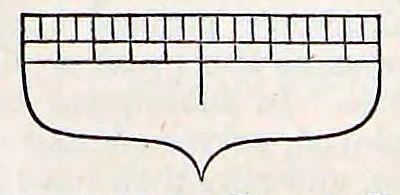
One Inch of the Great Pyramid, subdivided into tenths and half-tenths, and equal in length to one 500-millionth of the Earth’s Axis of Rotation.
N.B.—The above pictorial representation must be considered approximate only, on account of the expansions and contractions of the paper it is printed on, from moisture.